I run a company that sells about twenty thousand different things, and the question I get most from other founders is some version of: why? Wouldn’t you make more money with a hundred?
Disclosure first, since this is my business: I’m describing a strategy I’m paid by. I’ll show you the reasoning and the costs, not just the parts that flatter it.
The conventional answer is a hundred things
The standard way to build a foodservice supply company is to go long and deep. Pick a product, say a cup or a straw, learn to make it cheaper than anyone, and chase volume. Big chains buy in enormous quantities. If you win one of those accounts you have a business.
I have nothing against that model. It’s just not one I wanted to be in. Three things about it bothered me when I started in 2010, and they still do.
The margins are thin, because the product is a commodity and everyone knows the price of a commodity. The customer has most of the leverage, because a chain buying cups by the truckload can walk across the street for a fraction of a cent. And there’s not much new technology in it. A cup is a cup.
So I made the opposite bet. Let other people fight over pennies. We’d create value with selection and a broader offering, and we’d offer something better and different to the operators the volume players aren’t built for. I said as much to Chief Executive in 2024, and I’d say it again today.
What twenty thousand things actually is
The number sounds like chaos. It isn’t, once you see how a catalog is built.
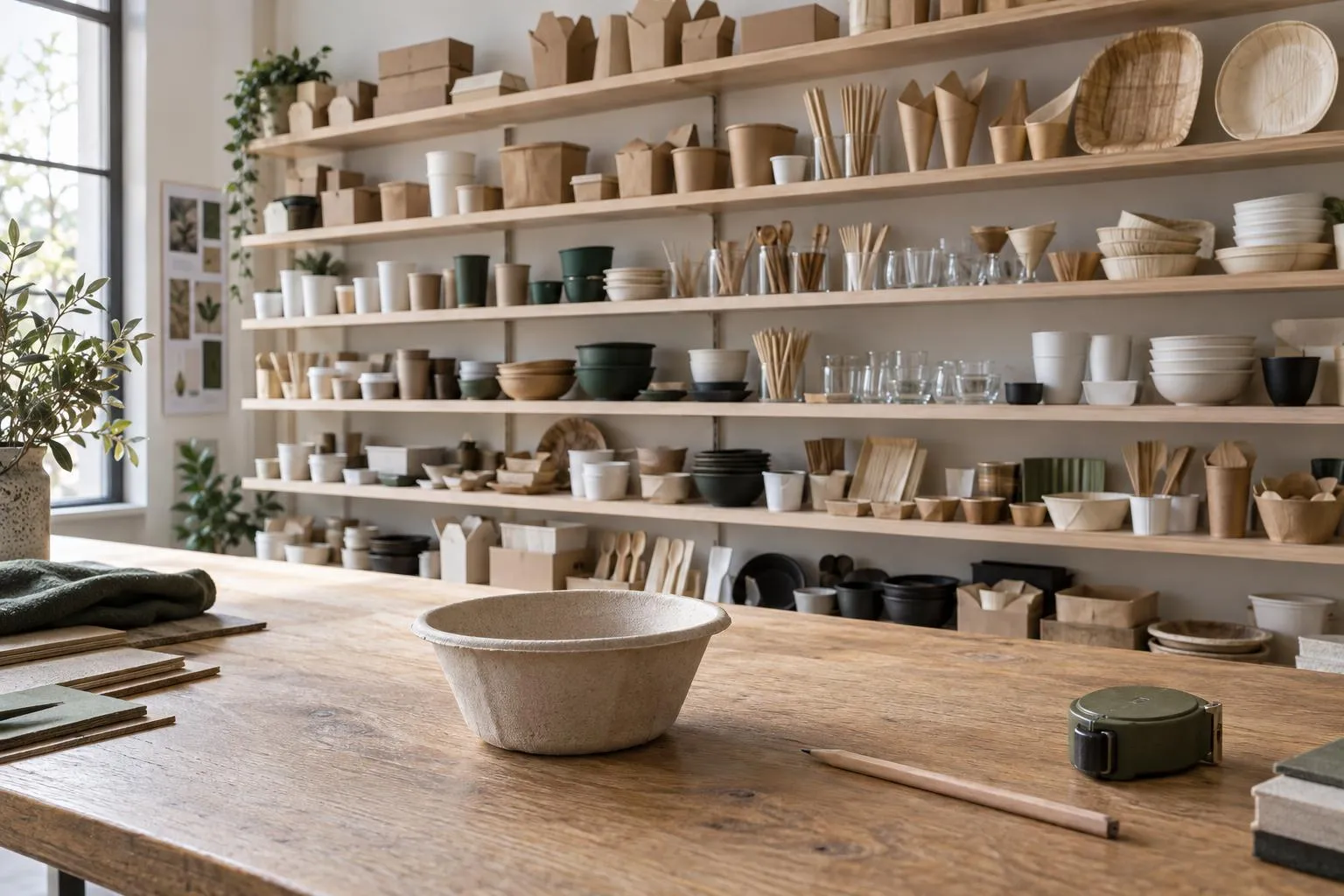
Twenty thousand items is not twenty thousand ideas. It’s a much smaller number of ideas, each one worked out across the dimensions a kitchen actually orders by. A seven-ounce bowl is one idea. That bowl in sugarcane fiber, in palm leaf and in porcelain is three. Each in two colors is six. Each in a 25-count box for the café and a 500-count case for the caterer is twelve. One idea, twelve listings, and every one of those twelve exists because a specific kind of operator asked for exactly that one.
That’s what breadth is for. A restaurant is a point of view about food, and the plate is part of the dish. If I only sell the bowl in one material, one color and one case size, I’m asking every operator to look like every other operator. A long catalog lets a place look like itself.
Who we’re actually for
The other half of the logic is the customer.
If you open a coffee shop tomorrow, you don’t have the budget for a hundred-thousand-bag order, and you shouldn’t want it. You need a few cases this month and the option to change your mind next month. The volume players can’t serve you profitably. Their whole machine is built around the big order.
Ours is built around hundreds of small ones. Chief Executive summed it up in 2024 better than I usually do: if a customer can imagine a new application, we try to make it, and we grow by satisfying hundreds of small orders. That’s a different operation top to bottom. Different minimums, different warehouse, different website, a different kind of salesperson.
It also happens to be where the interesting customers are. The independent, the regional chain with a limited-time menu, the hotel that wants its room-service tray to feel like the hotel. They care about how the thing looks in a guest’s hand. They’ll pay for better, and they’ll notice different.
The catalog is a portfolio of experiments
Here is the part I think most people miss about a wide catalog. It’s not a store. It’s a test.
We try to identify a need and test as many products as possible into the market. Then the market votes. Some items find a customer we didn’t predict. Many sell modestly forever. A meaningful number don’t sell at all, and the honest job is to notice quickly and stop.
A narrow company has to be right about its one product. A wide one can be wrong often and cheaply, because no single item has to carry the business. When I told an interviewer that we’d grown the catalog by 125 percent in two years, to about eight thousand items at the time, the unspoken half of that sentence was that we’d also killed a lot of things along the way. Both halves are the strategy. By 2024 the catalog had passed ten thousand. Today it is about twenty thousand.
The winners from that stretch make the point. Among the lines that grew fastest were our Pulp Safe items and PLA tableware, up 343 and 98 percent over two years. In 2010 I would not have bet the company on a bowl pressed from sugarcane fiber. I didn’t have to. The catalog found it, and the customers told us it was right. Palm-leaf tableware grew even faster in that same stretch, 245 percent, and we no longer sell it. That is not the model failing. That is the model.
What it costs
I’d be lying if I said breadth is free. It’s an expensive way to run a supply company, and the cost is complexity.
Every one of those twenty thousand items needs photographs, dimensions, a weight, a case pack, a vendor, a forecast, a slot in a warehouse, a page on the website and a person who understands it well enough to answer a question about it. Multiply any small sloppiness by twenty thousand and you have a real problem. A wide catalog is a discipline business pretending to be a creative one.
It also means inventory risk is spread across thousands of decisions rather than concentrated in a few. That cuts both ways. No single bad bet can sink us. But a hundred small bad bets, left alone, quietly can. So we spend an unglamorous amount of time on which items to stop making. Saying no to a product is as much a part of this model as saying yes.
And it means sourcing has to be flexible. We make, contract and partner across Asia, and in 2023 we opened our first U.S. factory in Paso Robles, California, built for short runs: limited-time delivery-bag lines, embellished labels for wine bottles, the small specific job a big plant won’t take. Over the next several years I want our own output on a par with our contract and import partners. What that building gives us today is the ability to say yes to a small, specific thing quickly.
Why I’d do it again
People sometimes read a long catalog as indecision, as if we couldn’t pick. It’s the opposite. The decision was made in 2010, and everything since has been consequences.
The decision was that the operator who can’t place a giant order still deserves good things, that selection is a form of value in its own right, and that a company willing to carry the complexity of breadth would have the field mostly to itself. Sixteen years and about two hundred and fifty people later, across the U.S., Europe, the U.K., India and China, that’s still the bet.
Could we make more money with a hundred products? Possibly, for a while, until a bigger company with a cheaper cup decided it wanted our hundred. The wide catalog is harder to copy because it’s not a product. It’s a habit: find the need, make the thing, watch what happens, keep or kill, repeat twenty thousand times.
That’s why we sell twenty thousand things. Not because we can’t choose, but because choosing, over and over, is the whole job.
Sources: Dale Buss, “How To Put Mass Customization To Work,” Chief Executive, March 7, 2024 (more than 10,000 SKUs, roughly 160 employees in the U.S., India and China, Paso Robles factory opened in 2023). Innovation Strategy, founder interview, undated (catalog growth of 125 percent over two years to a portfolio of 8,000 SKUs; palm-leaf tableware, Pulp Safe items and PLA tableware up 245, 343 and 98 percent over two years). Restaurantware was founded in 2010. Current catalog size, headcount, team geography and the palm-leaf discontinuation are the author’s own figures as of October 2026.