Once people hear about the Green Hero Foundation, I get some version of the same question: why is a company that sells disposable plates, cups and containers paying for mangroves in Tanzania and bison on the prairie?
It’s a fair question. The answer is less noble than a press release would make it sound, and more useful.
Disclosure first: I chair the Green Hero Foundation, and it is funded by Restaurantware, the company I own and run, through purchases across our catalog. So I’m describing my own project, and I have every reason to make it look good. I’ll stick to what we have put on the public record, and I’ll be as plain about what it isn’t as about what it is.
The honest starting point
“When you sell foodservice disposables, you have to think about what happens after the meal ends.” That sentence opened our launch announcement on July 29, 2025, and I still think it’s the right place to start.
We spend most of our time on the product side of that problem: what a piece is made of, how it performs, where it ends up. That work matters, and I’ve written about it here. But even a very good container has a limit. The premise we wrote into the foundation’s mission at launch was simple: whatever a product does or doesn’t do at the end of its life, it cannot restore what has already been lost.
That’s the gap the foundation is for. A better cup is about the next meal. A restored mangrove is about damage done long before any of us were in this business. Those are different jobs, and I don’t think one should be dressed up as the other.
What it funds: trees
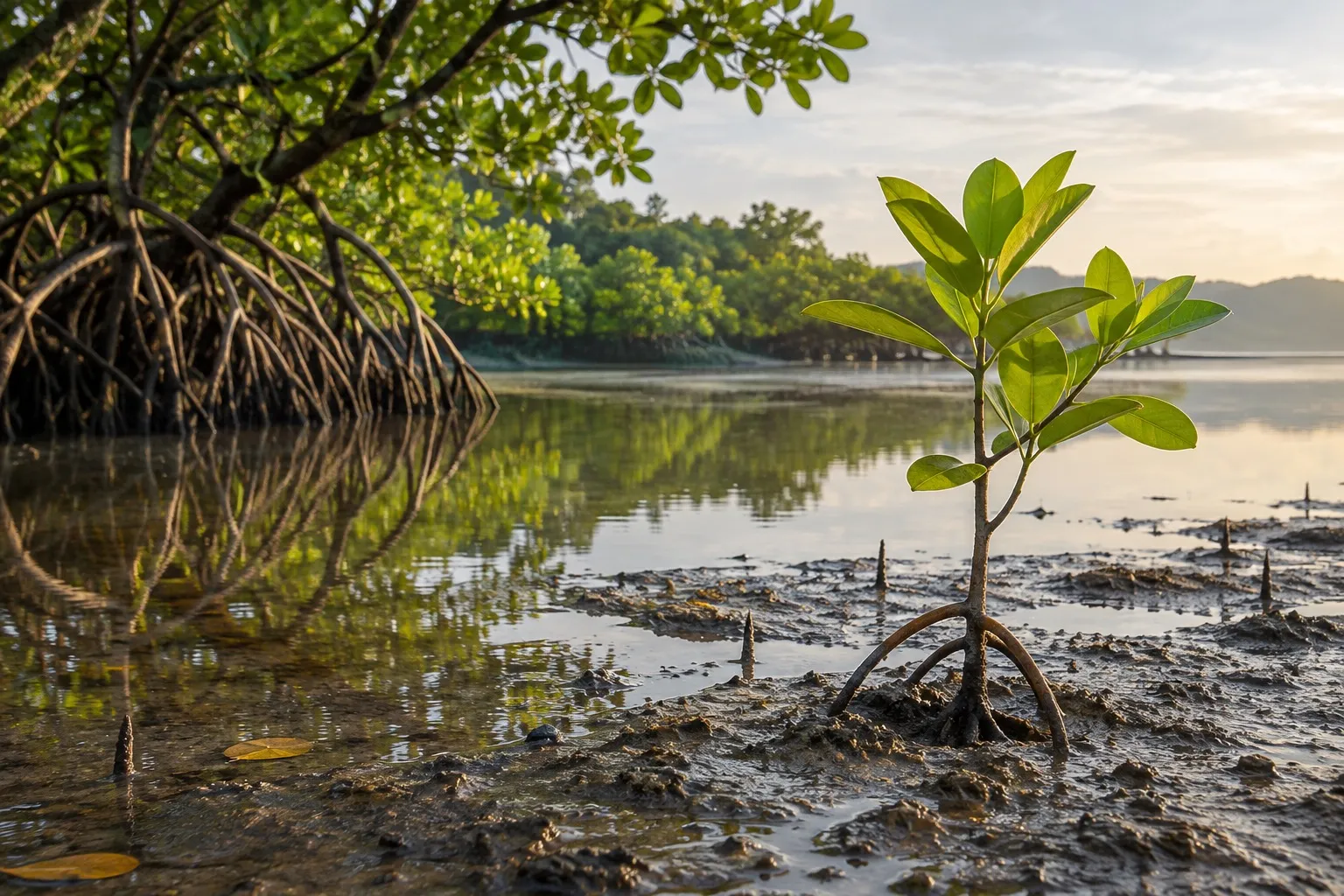
The oldest piece of the work predates the foundation. In March 2021 we started a program called Plant One on Us: for every purchase on Restaurantware.com, we plant a tree, in partnership with a reforestation company called veritree. The foundation now stewards that program.
By our 2025 Impact Report, released in February 2026, the program had passed 373,000 trees. The report names the sites: mangrove restoration in Tanzania and Kenya, including Tanga and Pangani on the Tanzanian coast; reforestation in Maranhão, Brazil; and agroforestry with farmers in Senegal. Our launch announcement also listed longleaf pine forests in Florida.
I care less about the number than about whether the trees are real. Tree counts are among the easiest numbers in sustainability to inflate, so the partner matters more than the press release. veritree describes a process in which planting partners collect ground-level data and evidence through its app; the data is checked “to ensure that the trees are not being double counted and that each tree is incremental”; every planting session goes through three levels of verification; and verified impact data is published to a public blockchain.
I can’t audit a mangrove in Tanga from Miami. What I can do is pick a partner whose business is proving it, and tell you who that partner is.
What it funds: keystone species
The second piece is newer, and it’s the part I find most interesting.
In the 1960s an ecologist named Robert Paine ran an experiment in the rocky tide pools of Washington state. The top predator there is the Pisaster sea star. Paine kept one stretch of shore free of sea stars and left an adjacent stretch alone as a control. The result surprised people. Without the predator, acorn barnacles crowded out most other species, and months later California mussels overran the barnacles. Diversity fell. Where the sea star stayed, it held.
Paine published the experiment in 1966. In 1969 he gave the idea its name, keystone species, and summed it up this way: “patterns of species occurrence, distribution and density are disproportionately affected by the activities of a single species of high trophic status.” Pull the keystone and the arch comes down. JSTOR Daily’s summary of what this means for conservation is the cleanest one I’ve read: protect the keystones, maintain the system.
That logic is why the foundation’s first year centered on the Keystone Preservation Project, run in partnership with Defenders of Wildlife. The impact report lists the work: seagrass beds and warm-water springs for the Florida manatee; Indigenous-led efforts to bring American bison back to the grasslands; a petition for protections for the pinyon jay, a bird that plants the pinyon-juniper woodlands of the Southwest; nonlethal coexistence strategies for gray wolves and grizzly bears; prairie dogs; kelp forests and sea otters; and habitat for monarch butterflies.
I like this model for the same reason I like a well-built supply chain: leverage. If a handful of species hold a system together, money spent on them goes further than money spread thin across everything.
What else is on the list
The foundation’s website lists a third initiative as upcoming, and it’s the one that matters most to me as a packaging person: supporting the development and promotion of local recycling and composting facilities. I’ve argued here before that compostable is a system you join, not a product you buy. A compostable plate with no facility within reach is a good intention with nowhere to go. Infrastructure is the unglamorous piece, and it’s the one our industry needs most.
At launch we also committed to education: school partnerships, awareness campaigns, and helping chefs and operators make better-informed decisions about the products they use. Like the facilities work, that is still more plan than track record, and I’d rather say so than round it up.
What it is not
This is where I want to be careful, because corporate foundations have earned the skepticism they get.
It is not a substitute for the product work. A tree planted in Senegal does not change what a container is made of or where it ends up. The foundation says nothing about any product’s environmental performance, and nobody should read it that way. Our launch announcement put the relationship in one word: separately. Products on one side, restoration on the other.
It is not a ledger. I’m wary of anything that nets trees against cups, and I don’t want a planting count read as permission to stop improving what we make. The two jobs don’t cancel out. Each one has to stand up on its own.
And it is not pure altruism. The funding is tied to purchases, and the impact report names product lines whose sales fuel the work. That helps us sell. I’d rather say that out loud than pretend otherwise. The honest version of corporate giving, in my view, admits the business benefits and then lets the receipts speak: what was planted, where, and verified by whom.
Why a packaging company, specifically
Michael Moore, our Chief Sustainability Officer and the foundation’s vice chair, put the standard well in the February 2026 release: “This isn’t just about the number of trees; it’s about the quality of the impact.”
The reason it fits a company like ours is structural. Our business runs on a very large number of small transactions: a case of cups here, a sleeve of lids there. One tree per order sounds trivial on any single invoice. Repeated across every order since 2021, it has become more than 373,000 trees. That’s the same compounding that built the business, pointed at something that doesn’t show up on our income statement.
There’s also a simpler reason. A lot of what we sell starts as a plant: sugarcane fiber, bamboo, wood, paper. The natural systems behind those materials don’t get rebuilt by a better lid. Somebody has to fund the rebuilding directly, and I’d rather it be the companies that depend on those systems than wait for someone else.
Where I land
So why does a packaging company run a conservation foundation? Because our products have an end, and what has already been lost doesn’t come back on its own. The product work is how we try to do less harm. The foundation is how we try to put something back.
I’d rather do both, keep them separate, and show the receipts for each. Judge the foundation on those receipts, not on this essay.
Sources: Restaurantware, “Restaurantware Launches The Green Hero Foundation To Advance Ecosystem Restoration And Sustainability In Foodservice,” PR Newswire, July 29, 2025 (opening line, mission premise, Jamil Bouchareb as owner and CEO, product counts by material, launch reforestation sites including Florida longleaf pine, planned keystone habitats, education commitments, Defenders of Wildlife partnership, “separately” quote). Restaurantware, “Green Hero Foundation Marks One Year Anniversary with Nationwide Wildlife Recovery and 373,000 Trees Planted,” PR Newswire, February 17, 2026 (2025 Impact Report; the release describes it as a one-year anniversary: over 373,000 trees, Plant One on Us since 2021, Tanzania and Kenya mangroves including Tanga and Pangani, Maranhão, Senegal, Keystone Preservation Project species list, Michael Moore quote, purchase-linked funding). The Green Hero Foundation website, greenherofoundation.org (Plant One on Us introduced March 2021 with veritree; recycling and composting facilities initiative). veritree, “How It Works” (data collection, double-counting and incrementality check, three levels of verification, public blockchain). JSTOR Daily, “The ‘Keystone Species’ Concept That Transformed Ecology,” on Robert T. Paine, The American Naturalist 100 (1966), 65–75, and Ecology 50 (1969), 950–961 (Pisaster removal results, keystone definition quote, “protect the keystones, maintain the system”). The author chairs the Green Hero Foundation.